Friday, September 29, 2006

Chennai Traffic Police and Roads: Why do Indians never learn?

Just a few days ago, I wrote about the death at dawn of an unknown motorcyclist at the junction of Inner Ring Road (Jawaharlal Nehru Salai) and Ashok Nagar Police Station Road.

I had called up the police control room and complained about the lack of supervision at 6 in the morning, when motorists are possibly at their worst behaviour.

Today, I was again passing through the same roads and found that traffic lights at the following junctions were simply ignored by the motorists:

  • Ashok Nagar Police Station - Ashok Pillar Road
  • Inner Ring Road - Ashok Nagar Police Station Road
  • Inner Ring Road - Jawahar Vidyalaya point

    Trucks, omnibuses and Metropolitan Transport Corporation buses threatened to run over people and ram into vehicles that took care to follow the lights, precisely at the same point where just a few days ago, one man had died.

    I have been asking the following simple question to anyone willing to listen in the police establishment: if you have no intention to enforce the traffic signals, why do you switch them on early in the morning in the first place?

    Don't the Police realise that it is better to tell motorists to "negotiate" carefully, rather than ask them to obey traffic lights? Otherwise, rogue drivers will not bother to stop at red lights and, as they have done in many instances, ram into you from behind?

    It is horrifying that the average citizen is at the mercy of a system that is both completely non-functional and, for the most part, hopelessly corrupt.
  • Tuesday, September 26, 2006

    YouTube videos on Indian roads

    I just saw that Paul Barter has excellent links to videos about traffic in South Asia and India in particular, on his blog.

    It is worth looking at the impact of automobile dependence and absolutely, totally ignorant policymaking in India. Great stuff for those who may be visiting India. This is something that adds nicely to Google Earth. You know that when you land in those places shown in the maps, this is the terror that awaits you!
    No "glocal" city

    Chennai, like many other Indian cities, is going global. I am provoked to provide this cliched view of a city (that has had a rather long international association from the days of the somewhat disreputable Robert Clive) because there is now a visible post-independence population of "foreigners" here, all of whom have to literally breathe the local air, join the powerless pedestrians, use the roads, weave past obstacles and generally avoid being run over.

    There are many who have to put up only with item number one. That is the air. Everything else one can buy in a "cleaned up" form.

    This is something of an irony for the Hyundais, the Mitsubishis, the Fords, the Suzukis, the Fiats, Mercedes, BMW, Audi (and any other automobile company that will come to India), because they are all eagerly setting up automobile plants. These companies achieve the depressingly negative outcome of adding to global warming and reducing, ironically, the level of mobility in the city by crowding out cyclists and buses, while promoting gridlock.

    To that list of course, one must add the local manufacturers of cars (Tatas...) and motorised scooters and bikes a few hundred of which hit the city roads everyday.

    On Monday, I just missed taking a picture of a group of people of African origin being escorted across the road by an autorickshaw driver. It was a funny scene. The auto man had his hand raised in a gesture of helpless pleading as the flock of ageing visitors followed him. Everyone was nervous in the group. Not without reason, because motorists are usually impatient on the somewhat wide road with the red lights. Pedestrian crossings are usually ignored and there are no major subways available for several kilometres (between LIC and, say, Safire). This scene at the Spencer's Junction on Anna Salai (the famous Mount Road of yore) is, incidentally, supposed to be monitored by police closed circuit satellite television! Take it from me, it is money down the drain. The system does not work.

    This is just my point. This city of flashy cars and discotheques is hopelessly barbaric when it comes to the roads. Yet, few businesses that set up here appear concerned about their impacts on the already deteriorating quality of life. I am not asking for their understanding. I am demanding that they realise social responsibility. I am not also xenophobic. It is just that we have a lot of problems from ignorant, unregulated, corrupt, unaccountable and completely greedy domestic businesses. We don't need further input of irresponsible capital powered by the deliberately weak state of the rupee and the seemingly insatiable appetite of Indian consumers to add to the chaos.
    Interesting perspective

    Fellow resident Scott Carney has a blog with a post on the state of chennai traffic, which I find has some interesting views. He is off the mark when it comes to some facts, starting with how much traffic police make (legally). Gone are the days when traffic policemen were paid less than a thousand rupees a month. Anyway, here is his take on some of the madness. Scott Carney Online

    Saturday, September 23, 2006

    A Death

    On Saturday morning, what I had feared for long ultimately happened. At the junction of the chaotic Inner Ring Road and 11th avenue Ashok Nagar (leading from the local police station), a man lay dead.

    He was a two-wheeler rider, one more added to the statistics of vulnerable road users who could not survive India's rapid slide into automobilisation and vehicle dependence. His body lay on the road, with policemen who had appeared in strength after the accident (road rules are not otherwise enforced on this busy road that caters to all of the traffic including thousands of buses and often trucks going from south to north).

    Paul Barter, the sustainable transport campaigner and researcher whom I have met in Kuala Lumpur used to say that if you know the cause of something, it is not an accident any longer.

    We know what killed the motorcyclist on Saturday morning. It was a combination of ignorance, indifference, lack of enforcement and finally, the rising tide of automobilisation in India.

    The response of authority was revealing. A policeman on the scene was irritated with my questions. I asked, "Of what use is it for you all to be present after someone is dead?"

    "The fellow was in the wrong....(expletive deleted)"

    The Hindu, the most respected newspaper in the city did not report this accident (though its City Editor was informed about it).

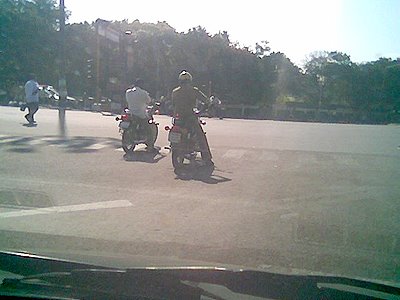
    Then again, for an idea of the kind of police that manages India, look at this image. The policeman is no better than the person to his left, standing in the fading zebra lines earmarked for the pedestrian!

    these are the enforcers!

    We stupid Indians...we will follow rules in Dubai, in Singapore, in the US and in London. Right here, where we live, where our kith and kin are exposed to danger on the road everyday, we are a hopelessly indisciplined lot. Is it any wonder that at least 80,000 of us will die in 2007 in road crashes and millions of us will nurse injuries sustained on the road?

    Tuesday, September 19, 2006

    Lalu Prasad and the Railway

    This is an image change that qualifies for serious study. In the popular imagination, often embellished by media images, Lalu Prasad the politician is often laughed at for his "rustic" persona. Now Railway Minister Lalu has gone to the Indian Institute of Management at Ahmedabad to talk about the turnaround of the Indian Railway.

    If commanders hold the key to the victories of armies, Lalu must certainly be commended for the book profits that the Railways have shown in the past year. It is of course, another matter that the Indian Railway -- even with an impressive record of moving millions -- is far from perfect. I have carried several pictures in the other posts on this.

    But without pessimism or cynicism, let us hope that Lalu will preside over an administration that will professionalise and modernise the railways and attract more people to undertake train travel. That he will provide the ageing and antiquated suburban railway stations of Chennai with escalators, lifts, clean entrances, eating places, ticketing booths, park and ride centres, information systems on train shedules, routes and system maps.

    Lalu's speech in Parliament on the Railways, during the budget presentation is worth reading, in the light of the kudos he is now receiving. It is found here.

    Thursday, August 31, 2006

    Music on the move

    It is no exaggeration that a ride on a train in this country will provide an interesting glimpse of the diversity of its social life.

    On a suburban train, one can see those who have been generally failed by the Indian welfare system, starting with blind people trying to sell cheap plasticky stuff to earn a living, fruit vendors, mendicants, street performers and vagabonds.

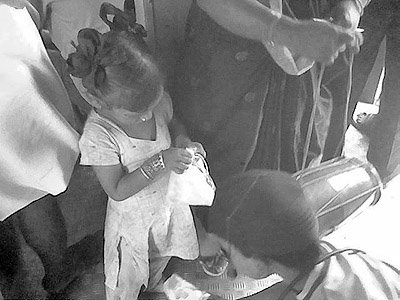
    I saw this girl with a slightly older boy and a woman, presumably all from the same family, performing minor contortionist tricks on the train. The boy and girl danced briefly to the beating of a drum by the woman, then wriggled through tight metal rings, before seeking alms from the passengers. After their first act, the children were fascinated by the sight of another train moving in the same direction on the adjacent track, its horn loudly blaring. They smiled at each other and momentarily suspended their circus.

    a life on a train

    To the credit of most people, they parted with at least 50 paise, and I was quite sure that if this troupe could carry on with its act regularly (though that would be possible only until the kids remained 'small') they would at least stave off hunger.
    A information entrepreneur

    It was funny to read in The Hindu the other day, that Chennai's monopoly bus operator, the Metropolitan Transport Corporation does not have a printed bus guide.

    It was funny because the MTC many years ago produced not just a guide giving route information, but even a good system map. It appears that as technology advances, policy regresses and a well-run transport network has gone to seed.

    Back to the question of travel and transit guides, I found an entrepreneur on board a Tambaram - Beach suburban train selling an interesting pocket guide for the wholly affordable price of three rupees. Besides a set of time-tables for the suburban rail system, it has details of the State Express Transport Corporation bus services, emergency phone lines for hospitals, 24-hour pharmacies and call taxi companies.

    The guide contains the following address: English Tamil Publications, 29.81, Red Hills Road, Opposite Gupta Convent, Villivakkam, Chennai 49. Phone: (044) 2617 4439.

    This nifty guide suggests that it would make an ideal hand-out for trade unions, film fan associations, political parties, residents welfare associations and so on. I completely endorse the value of such a publication.

    Saturday, August 26, 2006

    Stone surprise

    It is intriguing that the passage leading to the Kodambakkam suburban railway platforms presents a solid concrete stone bang in the centre. They are puzzled because the stone serves no apparent purpose.

    Remember that at dusk, this passage is plunged in darkness and unless you are a regular commuter, you may not be able to spot this stone. The results of such failure are all too imaginable.


    Not your lucky stone!

    In the background is the staircase leading to the platforms. More about that later. I am riding a lot of trains these days and have come to call these staircases the "42 steps."

    Here are a few pictures from the past couple of days. This is what Chennai's suburban railway looks like. More to come, of course.

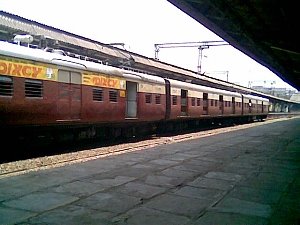
    A three car train that runs between Thirumailai (Mylapore) and Chennai Beach:

    MRTS train of three cars


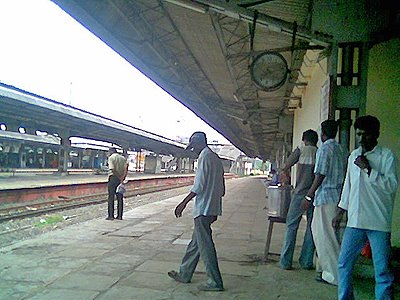
    The new train information system installed with the sign "on trial" at Kodambakkam station. It did not appear to be too accurate and as you can see, there is no clock in the board itself. You would have walk further on the same platform to spot the clock! If this system had been electronic (as it is in airports and even some major Indian railway stations) many display terminals could be connected to show the same information. So why is the wheel being reinvented?


    New information board at Kodambakkam


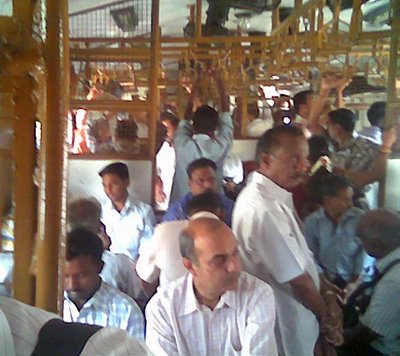
    The inside of some of the more recently introduced trains on the Chennai suburban railway looks like this. Considering the ramshackle past, this is welcome, but it lacks system maps and wastes opportunities to communicate useful information to a large commuter population. Note the man squatting in the passage (partly seen). Quite common in Indian trains.

    Insides of steel - one of the newer coaches

    Tuesday, August 22, 2006

    The railroad - the sensible road ahead

    As the Americans call it, it is the railroad. We know it as the suburban train, and in London, it is the tube. To many others, the modern versions are the Metro trains.

    Whatever moniker suits you, the train does a lot of good to Chennai. Only, it is still in its antiquated Victorian state, rather than modernise with the times just as the Ambassadors and Fiats have given way to the Marutis, Hondas, Fords, Skodas and Toyotas. Of course, Chennai's buses also remain hopelessly primitive and the design of even new bus bodies obsolete.

    As someone who uses trains everywhere (I have had occasion to use urban rail in London, New York, Washington DC, Paris, Berlin, Hamburg, Munich and Hong Kong) I cannot help noticing the miserably archaic train system that we have in Chennai.

    The only redeeming thing about the train is its capacity to carry a large number of people. Otherwise, it is simply, hopelessly outdated in terms of infrastructure and operations.

    Here is a glimpse of a station for the most recently introduced train, running on the Mass Rapid Transit System line:

    To be fair, this is Fort Station, which is at the surface level. Half a kilometre from here, the MRTS goes on to an elevated section.
    But look at the non-working clock, the lack of any signages for passengers indicating basic train information. The ticketing systems are simply pathetic. One has climb a steep flight of stairs to reach the ticketing office and then move to the MRTS platform.
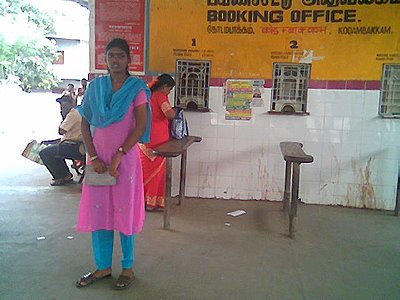
    An example of the ticketing offices of the suburban train system in Chennai is this one, at Kodambakkam on the Beach -- Tambaram line.


    This office is deep inside the station, on the platform. The downside to that placement is that if you have a train coming in, you would have to sprint up to the office, to get your ticket and then jump on to the train. Being entirely manual, the ticket system is slow, involving a queue in most cases.


    The worst disincentive to using the suburban railway system is the lack of automation in the form of escalators to reach the platforms. The approach to the suburban train stations, particularly those on the Beach - Thiruvanmiyur section, is invariably dark, dank and dirty. This puts off many potential travellers.

    Monday, August 21, 2006

    Car-free Sunday

    A week after the Hyundai Elantra knocked my car out of circulation, it was another Sunday. On a day like this, you become aware of how severely car-dependent you are, because India's (more particularly, Tamil Nadu's) policymakers have all but abandoned expansion of bus systems. Trains don't really present an alternative except for long distance commuting. That leaves us with autorickshaws.

    Chennai's unregulated autorickshaw business is well-known. It is one of the costliest cities when it comes to hiring such intermediate transport. The fares approximate to between Rs.12 and Rs.15 a kilometre, arguably the highest in the country. The Governments led by both Ms.Jayalalithaa and Mr.Karunanidhi have over the last decade all but abandoned the need to regulate such feeder transport systems.

    There is thus no functioning law governing autorickshaws. If you have lived here long enough, you know where you can bargain more effectively and save a few rupees. Trying to hail a crusing autorickshaw in most neighbourhoods is simply useless because the drivers recognise a monopoly principle for stand autorickshaws. Only after your negotiation with the local stand autorickshaws can you hire one that is cruising (and may hence make a more reasonable fare demand).

    One of the reasons for this state of affairs is the long shadow of political parties on the transport sector. Let me explain: the major Dravidian parties saw early enough that given their inability to generate employment in most other sectors, urban transport was a means of providing a livelihood to the party faithful.

    Thus, autorickshaw permits are secured by the middle rung city political leaders (and sometimes by those associated with leading film personalities) and the autorickshaws are handed over to people from the lowest strata to operate. Given the lack of education and any system of oversight, a high degree of lumpenisation exists in the sector. In fact, in the early 1990s, autorickshaws became the symbols of lumpen-led attacks on political and other opponents. The autorickshaws also demonstrate their affiliations on the vehicles in the form of flags, stickers of party colours, photos of the leaders and so on, all in violation of the Motor Vehicles Act rules. At the same time, few of them have functioning brake lights, headlights, windscreen wipers and indicators, as required under the MV Act.

    Is it this vested interest the reason for not expanding the city's bus system, which has grown at the rate of about 100 buses a year for a decade, to serve a metropolis that has expanded in residential population terms by about a million and half people, and in area by a radius of 20 km in that period?

    The robust economic growth of the country has accelerated the demand for transport in Chennai, but the Governments have preferred to encourage private vehicle ownership over provision of public alternatives. Private participation in Chennai's transport system is seen as politically unacceptable, although the families of Dravidian politicians own powerful private television networks both in India and abroad.

    More on this later. Meanwhile, my car-free Sunday cost me and family Rs.200 by way of autorickshaw and bus fares.

    Friday, August 18, 2006

    Beyond the car windows

    For most city drivers, the world outside their car windows is a distant and remote place. But many such coccooned citizens in fancy cars come face-to-face with the inconvenient reality everyday.

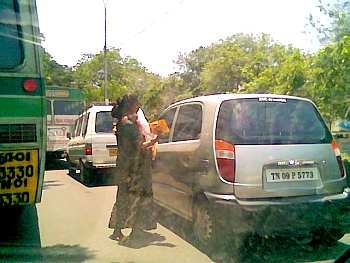
    I am talking about the scores of women and children who frequent the traffic intersections in Chennai, appealing to those inside the cars to buy vehicle-cleaning cloth, ear buds, in-car fancy dolls and other assorted stuff.


    On Independence Day, I saw this woman who was going from car to car, trying to sell miniature India's national flag displays. These are usually intended to be kept on the dashboard, a public show of patriotism in a land that has failed many of its citizens even after nearly six decades of independence.

    It is always worrying that some of these women and their children might come in harm's way, as they keep flitting between vehicles and scurry off just as the lights turn green.

    Thursday, August 17, 2006

    Yellow line fever

    I remember the film White Line Fever, in which monstrous trucks race across America. The world has changed a lot and it is now possible to track down crazed drivers, but in Chennai, it is now Yellow Line Fever.

    You might wonder what the purpose of these lines are. Police personnel occasionally take the trouble of painting these lines, continuous yellow or broken yellow and broken white lines that are supposed to mean something to drivers.

    But not in Chennai.

    Look at the response of drivers to plastic bollards that have been placed by traffic police on Anna Flyover at Gemini, and you get an idea of what I mean.

    Earlier, we had traffic ignoring the double yellow lines painted on the flyover, and going the wrong way into T.Nagar. They closed that entry at night, because vehicles began to have head-on collisions.

    Then, the police have a set of cones on the lines, to demarcate the two halves of the road. Many of those cones were crushed by drivers with impunity. After all, what do a few cones mean in a city that has no rules? People don't even stop at red lights here!


    So the police got plastic bollards, thin red cylinders about a couple of feet tall. We have seen even these getting crushed, because no one in the traffic police is ready to wait on the flyover and get the Mad Maxes who are knocking them down and crushing them!

    Look at the Lancer car in the picture, straddling the broken white lines, ignorant of what they are supposed to mean. The British brought the automobile to India, but they never taught Indians what lane discipline means. If you are getting very hot under the collar because I talk of the British, why not show me Indian leaders who have done better?


    Wednesday, August 16, 2006

    Rooftop riders, only this is not an open top tourist bus!

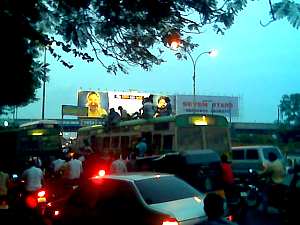
    How do you like this picture of some youths of Chennai riding on top of a city bus, celebrating in a style that may not be common in much of the civilised world?

    Riders do hang out of buses for want of space during peak hours, but I watched these urchins generally making a nuisance of themselves and keen on attracting attention through such antics. But in a country where it is difficult even to get your 15 minutes of fame, perhaps they don't have much choice!
    Footpaths for whom? Surely, not for advertisement billboards!

    It was Independence Day and I was out on the road, without a car but many a care.

    My mobile phone camera kept clicking pictures of Mera Bharat Mahaan. In a bus, looking at the dirty Cooum (river) behind the posh Connemara Hotel... Here is one picture of what is left of the footpath or sidewalk at Chennai's best known junction, Arts College.

    If it will impress you, this atrocity on pedestrians has been perpetrated with the help of the World Bank, which has been loaning funds to the Tamil Nadu Government in the name of improving civic infrastructure!
    Chennai roads, senseless drivers and South Korean indifference

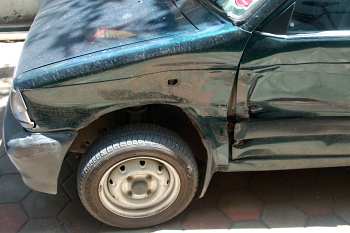
    I had started this blog after a bad accident in which the personal driver (Indian) of a Korean executive of the Hyundai company rammed an Elantra car into my small, meek, fuel-sipping Maruti 800 car on August 13, 2006.

    That post seems to have disappeared, so I am trying to recreate it here.

    As a buckled-up, bespectacled and somewhat timid (on the road) driver who is always at odds with the drive-as-you-please Chennai traffic, my experience on the road took a great turn for the worse on that day.

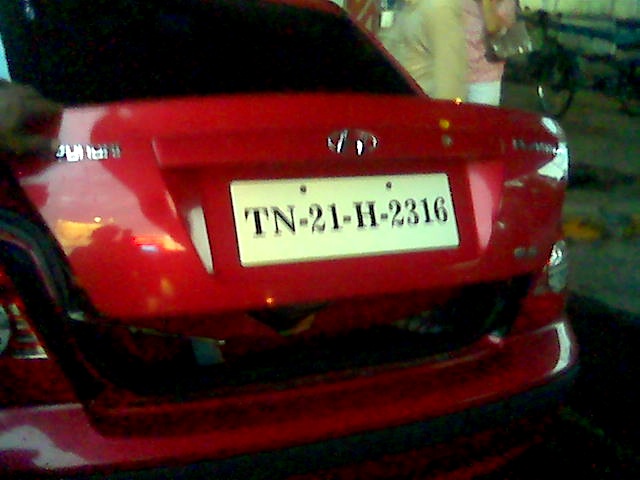
    A small town fellow, who gave his name as just Ravi proved my worst fears about Chennai traffic true. This ill-trained person at the wheel of a shiny wine red Elantra jumped the red signal at the junction of Music Academy on Radhakrishnan Salai and rammed his car into the side of my six-year old Maruti.

    I was following the green light and going with two occupants in the car towards Marina.

    Unlike the God after whom my pint sized car is named, the Maruti is a weakling when it comes to meeting metallic monsters in road combat.

    Therefore, this is the result:


    If you looked around the car, you would find that it does not have any dents elsewhere, in the six years that it has been on the road.

    All that it took to spoil that reputation is one "classic" Indian driver called Ravi. This man said he has a licence issued in Arni, a small textile town in northern Tamil Nadu not particularly famous for the civic sense of its drivers. Surely, not now.

    The occupant of the Elantra at the time of the accident, a Korean woman was completely engrossed in her own affairs, and she was content, as we found, talking to someone on the phone seated in the luxurious car. It mattered little to her that her personal driver had nearly killed three people after jumping a red light.

    Perhaps people don't bother about traffic lights in South Korea - or at least, those who are executives in Hyundai motors don't. What is worse, Koreans don't seem to have basic courtesy, if this lady is a model South Korean.

    If you are upset reading this particular part of the post, then you should sit inside one of the cars that Hyundai uses (presumably they do) for crash tests. It might give you some idea of what it feels like to be banged against some object.

    Anyway, back to Ravi, who kept repeating after the accident that he was driving a car that belonged to a "Hyundai owner," which was shorthand for the few traffic policemen who had gathered, that his employer was an influential person. So watch out, he was essentially telling them.

    Since my own car belongs to a major newspaper in this city, the police were in something of a quandary. They were relieved, in the event, to hear that they would only have to issue a certificate for insurance purposes, and not register a First Information Report and pursue the case and prosecute Ravi.

    All this should give you an idea of what Chennai roads are like, when it comes to -- sorry for the pun -- crunch. Incidentally, the road where the crash took place leads to the houses of both the present and former (and possibly the future) Chief Ministers of Tamil Nadu.

    I called up a colleague and he sought the good offices of a senior police officer to get the insurance certificate issued quickly. After all, since Ravi was going to go scot free despite attempting to murder three people using a Hyundai Elantra, why waste time with the formalities?

    So a somewhat bored head constable was asked to accompany me as I drove the battered Maruti several kilometres, to the J 2 Adyar Traffic Investigation unit at Besant Nagar. The certificate took only a short while to obtain. One must remember that the accident had taken place in full view of three or four traffic policemen, and at least 20 law and order reservists who were sitting inside a police truck, at the Music Academy junction. Why had not a single policeman stopped Ravi is of course less of a mystery, because that is the way Chennai (and much of India) works.

    In all of this, I must say that the seat belts of the Maruti really did their job. Neither me nor my kid in the front left seat (the side that took the hit) were shaken seriously, but a passenger in the back was thrown to the opposite side and left with some minor sprains and bruises in one arm. So never drive without the seat belt fastened.

    If you wanted to look at the stupidly driven Hyundai Elantra car this is it:


    The boot is ajar because the broken bumper of the car has been placed inside by the deviant driver.

    Let me say at this point that I don't care much for cars, and think they are all contraptions that are only useful to get from point A to B. In fact, I believe it is criminal to sell such monsters in large numbers in a poor country like India (yes, despite the tall talk of India shining and superpower status etc), to drink up precious fuel for the pleasure of a few (like the lone Korean woman inside this one), while the bulk of the people in Chennai are sweating it out in ramshackle buses and overcrowded trains. Perhaps if we had air-conditioned buses and trains operating at affordable fares (without long waiting times), and they were funded by taxing such profligate consumers, I would not feel so bad.

    All of which brings me to my pet raves and rants.

    I am a proud advocate of public transport, car pools, ride shares, congestion charging and costlier fuel. I just love those good trains, buses, trams and the wide sidewalks (or footpaths if you wish).

    You will find these themes recurring in this blog. So don't go away!

    Monday, August 14, 2006

    More on the Hyundai car crash episode

    I thought I should share the police certificate on the car crash. Here it is, in pdf form. If you drive a vehicle and haven't seen a certificate from police to claim insurance after an accident (involving no injury, because if someone is injured, an FIR is registered).


    Given the credibility of the enforcement mechanism of India's Motor Vehicles Act rules, the rash, negligent and arrogant driver of this car will not pay any penalty, other than the palm greasing that he did on the day of the accident. What is worse, he quickly sought the help of a off-duty constable to plead his case with me, urging that I should only ask for insurance money, and not file an FIR which would lead to a police investigation. Helps everybody, doesn't it? So Ravi can drive another of these cars stupidly and crash into another guy like me. Anyway, companies like Hyundai are there to bail out such untrained drivers who are employed practically as manservants in the house of the executives
    Here's why Onyx stinks

    We all know that Onyx, the international "waste specialists" who claim to have the best environment technologies elsewhere in the world, work only to transport trash in Chennai from houses to a dump in South Chennai, at Perungudi.

    I have a picture of an Onyx three wheeler piled high with trash, most of it rotting vegetable waste, speeding up on G.N.Chetty Road.
    So here's the image. Today is Wedneseday, August 16. This is the way Onyx carries much of the trash from parts of Chennai to the transfer stations, and from there, it is carted to the dump.